
markstream-custom-components
A Vue 3 renderer specifically built for AI-powered streaming Markdown: Monaco incremental, Mermaid progressive, and KaTeX formula speed, with real-time updates and no jitter, ready to use out of the box.
npx skills add https://github.com/simon-he95/markstream-vue --skill markstream-custom-componentsInstallieren Sie diesen Skill über die CLI und beginnen Sie mit der Verwendung des SKILL.md-Workflows in Ihrem Arbeitsbereich.
markstream-vue
Fast, streaming-friendly Markdown rendering for Vue 3 — progressive Mermaid, streaming diff code blocks, and real-time previews optimized for large documents.











Looking for other frameworks?
- Vue 2.6: use
markstream-vue2(a baseline port with fewer advanced features) - React: see
packages/markstream-reactatpackages/markstream-react/README.md(first-pass port)
Contents
- TL;DR Highlights
- Choose Your Path
- Try It Now
- Community & support
- Quick Start
- Common commands
- Streaming in 30 seconds
- Performance presets
- Key props & options
- Where it shines
- FAQ
- Why markstream-vue
- Roadmap
- Releases
- Showcase
- Introduction Video
- Features
- Contributing & community
- Troubleshooting
- Thanks
- Star History
- License
📖 Detailed docs, API, and advanced usage: https://markstream-vue-docs.simonhe.me/guide/
TL;DR Highlights
- Purpose-built for streaming Markdown (AI/chat/SSE) with zero flicker and predictable memory.
- Two render modes: virtual window for long docs, incremental batching for “typing” effects.
- Progressive diagrams (Mermaid) and streaming code blocks (Monaco/Shiki) that keep up with diffs.
- Works with raw Markdown strings or pre-parsed nodes, supports custom Vue components inline.
- TypeScript-first, ship-ready defaults — import CSS and render.
Choose Your Path
| If you want to... | Start here | Then go to |
|---|---|---|
| get the first render on screen | Quick Start | Installation guide |
| integrate it into a docs site or VitePress theme | Docs Site & VitePress | Custom Tags & Advanced Components |
| build an AI chat UI or SSE stream | AI Chat & Streaming | Performance |
| replace one built-in renderer | Override Built-in Components | Renderer & Node Components |
add trusted tags such as thinking |
Custom Tags & Advanced Components | API Reference |
| debug a broken integration but do not know why yet | Troubleshooting by Symptom | Troubleshooting |
🚀 Try It Now
- Playground (interactive demo): https://markstream-vue.simonhe.me/
- Interactive test page (shareable links, easy reproduction): https://markstream-vue.simonhe.me/test
- Docs: https://markstream-vue-docs.simonhe.me/guide/
- AI/LLM context (project map): https://markstream-vue-docs.simonhe.me/llms
- AI/LLM context (中文): https://markstream-vue-docs.simonhe.me/llms.zh-CN
- One-click StackBlitz demo: https://stackblitz.com/github/Simon-He95/markstream-vue?file=playground/src/App.vue
- Changelog: CHANGELOG.md
- Nuxt playground:
pnpm play:nuxt - Discord: https://discord.gg/vkzdkjeRCW
CLI helpers for skills and prompts
If you want the packaged AI assets without cloning the repo:
npx skills add Simon-He95/markstream-vue
npx markstream-vue skills list
npx markstream-vue skills install
npx markstream-vue prompts list
npx markstream-vue prompts show install-markstream
Recommended usage:
npx skills add Simon-He95/markstream-vueis the primary path for Codex-compatible skill discovery because it reads.agents/skillsdirectly from the GitHub repositoryskills installinstalls the bundled skills into your agent skill directory (default:~/.agents/skills)prompts listandprompts showto discover and copy maintained prompt templates
Other npx skills add forms also work:
# Full GitHub URL
npx skills add https://github.com/Simon-He95/markstream-vue

# Direct path to one skill in this repo
npx skills add https://github.com/Simon-He95/markstream-vue/tree/main/.agents/skills/markstream-install

# Any git URL
npx skills add [email protected]:Simon-He95/markstream-vue.git
💬 Community & support
- Discussions: https://github.com/Simon-He95/markstream-vue/discussions
- Discord: https://discord.gg/vkzdkjeRCW
- Issues: please use templates and attach a repro link (https://markstream-vue.simonhe.me/test)
The test page gives you an editor + live preview plus “generate share link” that encodes the input in the URL (with a fallback to open directly or pre-fill a GitHub Issue for long payloads).
Support the project
If markstream-vue helps your work, you can support ongoing maintenance with one of these QR codes.
| Alipay | WeChat Pay |
|---|---|
 |
 |
⚡ Quick Start
pnpm add markstream-vue
# npm install markstream-vue
# yarn add markstream-vue
import MarkdownRender from 'markstream-vue'
// main.ts
import { createApp } from 'vue'
import 'markstream-vue/index.css'

createApp({
  components: { MarkdownRender },
  template: '<MarkdownRender custom-id="docs" :content="doc" />',
  setup() {
    const doc = '# Hello from markstream-vue\\n\\nSupports **streaming** nodes.'
    return { doc }
  },
}).mount('#app')
Import markstream-vue/index.css after your reset (e.g., Tailwind @layer components) so renderer styles win over utility classes. Install optional peers such as stream-monaco, shiki, stream-markdown, mermaid, and katex only when you need Monaco code blocks, Shiki highlighting, diagrams, or math.
If your app intentionally scales root font size on mobile, use markstream-vue/index.px.css to avoid rem-based global scaling side effects.
Renderer CSS is scoped under an internal .markstream-vue container to minimize global style conflicts. If you render exported node components outside of MarkdownRender, wrap them in an element with class markstream-vue.
For dark theme variables, either add a .dark class on an ancestor, or pass :is-dark="true" to MarkdownRender to scope dark mode to the renderer.
Prefer the unified code-block theme prop for new integrations. When you render through MarkdownRender, pass it via code-block-props:
<MarkdownRender
  :is-dark="isDark"
  :code-block-props="{ theme: { light: 'vitesse-light', dark: 'vitesse-dark' } }"
  :content="doc"
/>
Language icons use the built-in material theme by default. Advanced integrations can inspect or switch icon themes with the exported helpers, or set an initial theme with app.use(VueRendererMarkdown, { iconTheme }):
import { getRegisteredThemes, setIconTheme } from 'markstream-vue'

console.log(getRegisteredThemes()) // ['material']
setIconTheme('material')
Use registerIconTheme() if you want to add your own icon pack.
Enable heavy peers only when needed:
import { enableKatex, enableMermaid } from 'markstream-vue'
import 'markstream-vue/index.css'
import 'katex/dist/katex.min.css'

// after you install `mermaid` / `katex` peers
enableMermaid()
enableKatex()
Optional: CDN-backed workers (KaTeX / Mermaid)
If you load KaTeX via CDN and want KaTeX rendering in a Web Worker (no bundler / optional peer not installed), inject a CDN-backed worker:
import { createKaTeXWorkerFromCDN, setKaTeXWorker } from 'markstream-vue'

const { worker } = createKaTeXWorkerFromCDN({
  mode: 'classic',
  // UMD builds used by importScripts() inside the worker
  katexUrl: 'https://cdn.jsdelivr.net/npm/[email protected]/dist/katex.min.js',
  mhchemUrl: 'https://cdn.jsdelivr.net/npm/[email protected]/dist/contrib/mhchem.min.js',
})

if (worker)
  setKaTeXWorker(worker)
If you load Mermaid via CDN and want off-main-thread parsing (used by progressive Mermaid rendering), inject a Mermaid parser worker:
import { createMermaidWorkerFromCDN, setMermaidWorker } from 'markstream-vue'

const { worker } = createMermaidWorkerFromCDN({
  // Mermaid CDN builds are commonly ESM; module worker is recommended.
  mode: 'module',
  workerOptions: { type: 'module' },
  mermaidUrl: 'https://cdn.jsdelivr.net/npm/mermaid@11/dist/mermaid.esm.min.mjs',
})

if (worker)
  setMermaidWorker(worker)
Nuxt quick drop-in
// plugins/markstream-vue.client.ts
import { defineNuxtPlugin } from '#app'
import MarkdownRender from 'markstream-vue'
import 'markstream-vue/index.css'

export default defineNuxtPlugin((nuxtApp) => {
  nuxtApp.vueApp.component('MarkdownRender', MarkdownRender)
})
Then use <MarkdownRender :content="md" /> in your pages.
🛠️ Common commands
pnpm dev— playground dev serverpnpm play:nuxt— Nuxt playground devpnpm build— library + CSS buildpnpm build:analyze— build with bundle visualizer reports (bundle-visualizer.html,bundle-visualizer-tailwind.html)pnpm size:check— run dist + npm package size budget checks (same guard used in CI)pnpm test— Vitest suite (pnpm test:updatefor snapshots)pnpm typecheck/pnpm lint— type and lint checks
⏱️ Streaming in 30 seconds
Render streamed Markdown (SSE/websocket) with incremental updates:
import type { ParsedNode } from 'markstream-vue'
import MarkdownRender, { getMarkdown, parseMarkdownToStructure } from 'markstream-vue'
import { ref } from 'vue'

const nodes = ref<ParsedNode[]>([])
const buffer = ref('')
const md = getMarkdown()

function addChunk(chunk: string) {
  buffer.value += chunk
  nodes.value = parseMarkdownToStructure(buffer.value, md)
}

// e.g., inside your SSE/onmessage handler
eventSource.onmessage = event => addChunk(event.data)

// template
// <MarkdownRender
//   :nodes="nodes"
//   :max-live-nodes="0"
//   :batch-rendering="{
//     renderBatchSize: 16,
//     renderBatchDelay: 8,
//   }"
// />
Switch rendering style per surface:
- Virtualized window (default): steady scrolling and memory usage for long docs.
- Incremental batches: set
:max-live-nodes="0"for AI-like “typing” with lightweight placeholders.
Advanced: SSR / worker / streaming handoff
SSR / Worker usage (deterministic output)
Pre-parse Markdown on the server or in a worker and render typed nodes on the client:
// server or worker
import { getMarkdown, parseMarkdownToStructure } from 'markstream-vue'

const md = getMarkdown()
const nodes = parseMarkdownToStructure('# Hello\n\nThis is parsed once', md)
// send `nodes` JSON to the client
<!-- client -->
<MarkdownRender :nodes="nodesFromServer" />
This avoids client-side parsing and keeps SSR/hydration deterministic.
Hybrid: SSR + streaming handoff
- Server: parse the first Markdown batch to nodes and serialize
initialNodes(and the rawinitialMarkdownif you also stream later chunks). - Client: hydrate with the same parser options, then keep streaming:
import type { ParsedNode } from 'markstream-vue'
import { getMarkdown, parseMarkdownToStructure } from 'markstream-vue'
import { ref } from 'vue'

const nodes = ref<ParsedNode[]>(initialNodes)
const buffer = ref(initialMarkdown)
const md = getMarkdown() // match server setup

function addChunk(chunk: string) {
  buffer.value += chunk
  nodes.value = parseMarkdownToStructure(buffer.value, md)
}
This avoids re-parsing SSR content while letting later SSE/WebSocket chunks continue the stream.
Tip: when you know the stream has ended (the message is complete), use
parseMarkdownToStructure(buffer.value, md, { final: true })or pass:final="true"to the component. This disables mid-state (loading) parsing so trailing delimiters (like$$or an unclosed code fence) won’t get stuck showing perpetual loading.
⚙️ Performance presets
- Virtual window (default) – keep
max-live-nodesat its default320to enable virtualization. Nodes render immediately and the renderer keeps a sliding window of elements mounted so long docs remain responsive without showing skeleton placeholders. - Incremental stream – set
:max-live-nodes="0"when you want a true typewriter effect. This disables virtualization and turns on incremental batching governed bybatchRendering,initialRenderBatchSize,renderBatchSize,renderBatchDelay, andrenderBatchBudgetMs, so new content flows in small slices with lightweight placeholders.
Pick one mode per surface: virtualization for best scrollback and steady memory usage, or incremental batching for AI-style “typing” previews.
Tip: In chats, combine
max-live-nodes="0"with smallrenderBatchSize(e.g.,16) and a tinyrenderBatchDelay(e.g.,8ms) to keep the “typing” feel smooth without jumping large chunks. TunerenderBatchBudgetMsdown if you need to cap CPU per frame.
🧰 Key props & options (cheatsheet)
contentvsnodes: pass raw Markdown or pre-parsed nodes (fromparseMarkdownToStructure).max-live-nodes:320(default virtualization) or0(incremental batches).batchRendering: fine-tune batches withinitialRenderBatchSize,renderBatchSize,renderBatchDelay,renderBatchBudgetMs.enableMermaid/enableKatex: (re)enable heavy peers or custom loaders when needed (pairs withdisableMermaid/disableKatex).parse-options: reuse parser hooks (e.g.,preTransformTokens,requireClosingStrong) on the component.final: marks end-of-stream; disables mid-state loading parsing and forces unfinished constructs to settle.custom-html-tags: extend streaming HTML allowlist for custom tags and emit them as custom nodes forsetCustomComponents(e.g.,['thinking']).setCustomComponents(customId?, mapping): register inline Vue components for custom tags/markers (scoped bycustom-idwhen provided).
Example: map Markdown placeholders to Vue components (scoped)
import { setCustomComponents } from 'markstream-vue'

setCustomComponents('docs', {
  CALLOUT: () => import('./components/Callout.vue'),
})

// Markdown: [[CALLOUT:warning title="Heads up" body="Details here"]]
Use the same custom-id on the renderer:
<MarkdownRender
  :content="doc"
  custom-id="docs"
/>
Parse hooks example (match server + client):
<MarkdownRender
  :content="doc"
  :parse-options="{
    requireClosingStrong: true,
    preTransformTokens: (tokens) => tokens,
  }"
/>
🔥 Where it shines
- AI/chat UIs with long-form answers and Markdown tokens arriving over SSE/websocket.
- Docs, changelogs, and knowledge bases that need instant load but stay responsive as they grow.
- Streaming diffs and code review panes that benefit from Monaco live updates.
- Diagram-heavy content that should render progressively (Mermaid) without blocking.
- Embedding Vue components in Markdown-driven surfaces (callouts, widgets, CTA buttons).
❓ FAQ (quick answers)
- Mermaid/KaTeX not rendering? Install the peer (
mermaid/katex) and pass:enable-mermaid="true"/:enable-katex="true"or call the loader setters. If you load them via CDN script tags, the library will also pick upwindow.mermaid/window.katex. - CDN + KaTeX worker: if you don't bundle
katexbut still want off-main-thread rendering, create and inject a worker that loads KaTeX via CDN (UMD) usingcreateKaTeXWorkerFromCDN()+setKaTeXWorker(). - Bundle size: peers are optional and not bundled; import only
markstream-vue/index.cssonce; use Shiki (MarkdownCodeBlockNode) when Monaco is too heavy. Infrequent language icons are split into an async chunk and load on demand; callpreloadExtendedLanguageIcons()during app idle if you want to avoid first-hit icon fallback. - Custom UI: register components via
setCustomComponents(global or scoped), then emit markers/placeholders in Markdown and map them to Vue components.
🆚 Why markstream-vue over a typical Markdown renderer?
| Needs | Typical Markdown preview | markstream-vue |
|---|---|---|
| Streaming input | Re-renders whole tree, flashes | Incremental batches with virtual windowing |
| Large code blocks | Slow re-highlight | Monaco streaming updates + Shiki option |
| Diagrams | Blocks while parsing | Progressive Mermaid with graceful fallback |
| Custom UI | Limited slots | Inline Vue components & typed nodes |
| Long docs | Memory spikes | Configurable live-node cap for steady usage |
🗺️ Roadmap (snapshot)
- More “instant start” templates (Vite + Nuxt + Tailwind) and updated StackBlitz.
- Additional codeblock presets (diff-friendly Shiki themes, Monaco decoration helpers).
- Cookbook docs for AI/chat patterns (SSE/WebSocket, retry/resume, markdown mid-states).
- More showcase examples for embedding Vue components inside Markdown surfaces.
📦 Releases
- Latest: Releases — see highlights and upgrade notes.
- Full history: CHANGELOG.md
- Recent highlights (0.0.3-beta.1/beta.0):
- Parser bumped to
[email protected]for parsing fixes. - Monaco upgrades with more languages/themes + diff-friendly code block tweaks.
- HTML/SVG preview dialog and AST debug view in the playground.
- Parser bumped to
🧭 Showcase & examples
Build something with markstream-vue? Open a PR to add it here (include a link + 1 screenshot/GIF). Ideal fits: AI/chat UIs, streaming docs, diff/code-review panes, or Markdown-driven pages with embedded Vue components.
- FlowNote — streaming Markdown note app demo (SSE + virtual window) — https://markstream-vue.simonhe.me/
- AI Chat surface — playground “test” page showing incremental batches + share links — https://markstream-vue.simonhe.me/test
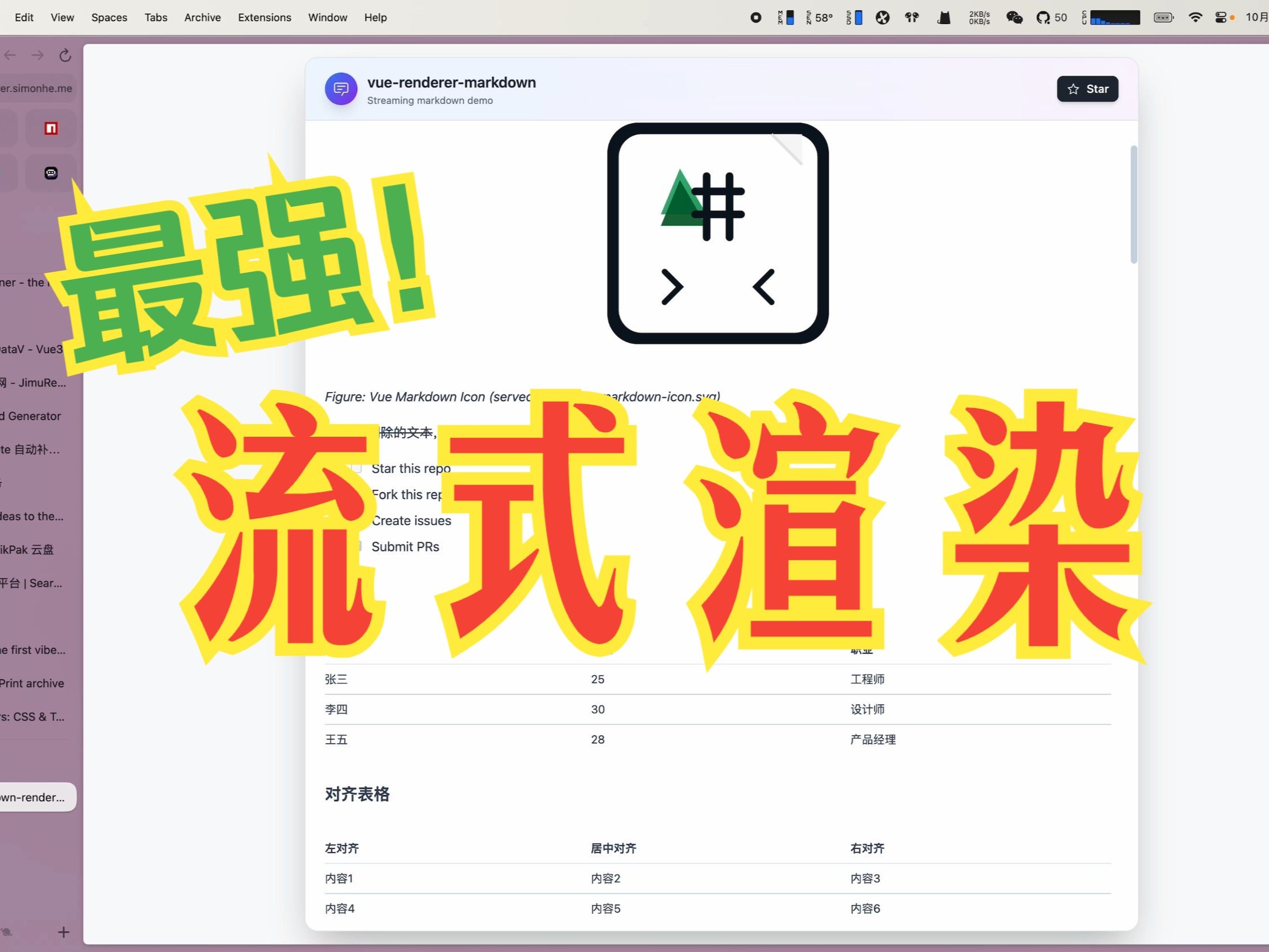
📺 Introduction Video
A short video introduces the key features and usage of markstream-vue:
Watch on Bilibili: Open in Bilibili
Features
- ⚡ Extreme performance: minimal re-rendering and efficient DOM updates for streaming scenarios
- 🌊 Streaming-first: native support for incomplete or frequently updated tokenized Markdown
- 🧠 Monaco streaming updates: high-performance Monaco integration for smooth incremental updates of large code blocks
- 🪄 Progressive Mermaid: charts render instantly when syntax is available, and improve with later updates
- 🧩 Custom components: embed custom Vue components in Markdown content
- 📝 Full Markdown support: tables, formulas, emoji, checkboxes, code blocks, etc.
- 🔄 Real-time updates: supports incremental content without breaking formatting
- 📦 TypeScript-first: complete type definitions and IntelliSense
- 🔌 Zero config: works out of the box in Vue 3 projects
- 🎨 Flexible code block rendering: choose Monaco editor (
CodeBlockNode) or lightweight Shiki highlighting (MarkdownCodeBlockNode) - 🧰 Parser toolkit:
stream-markdown-parsernow documents how to reuse the parser in workers/SSE streams and feed<MarkdownRender :nodes>directly, plus APIs for registering global plugins and custom math helpers.
🙌 Contributing & community
- Read the contributor guide: CONTRIBUTING.md and follow the PR template.
- Be kind and follow the Code of Conduct.
- Issues: use templates for bugs/requests; attach a repro from https://markstream-vue.simonhe.me/test when possible.
- Questions? Start a discussion: https://github.com/Simon-He95/markstream-vue/discussions
- Chat live: Discord https://discord.gg/vkzdkjeRCW
- Looking to contribute? Start with good first issues.
- Support guide: SUPPORT.md
- PRs: follow Conventional Commits, add tests for parser/render changes, and include screenshots/GIFs for UI tweaks.
- If the project helps you, consider starring and sharing the repo — it keeps the work sustainable.
- Security: see SECURITY.md to report vulnerabilities privately.
Quick ways to help
- Add repro links/screenshots to existing issues.
- Improve docs/examples (especially streaming + SSR/worker patterns).
- Share playground/test links that showcase performance edge cases.
Troubleshooting & Common Issues
Troubleshooting has moved into the docs:
https://markstream-vue-docs.simonhe.me/guide/troubleshooting
If you can't find a solution there, open a GitHub issue:
https://github.com/Simon-He95/markstream-vue/issues
Report an issue quickly
- Reproduce in the test page and click “generate share link”: https://markstream-vue.simonhe.me/test
- Open a bug report with the link and a screenshot: https://github.com/Simon-He95/markstream-vue/issues/new?template=bug_report.yml
Thanks
Contributors
Thanks to all the people who have contributed to this project!
Dependencies
This project uses and benefits from:
Thanks to the authors and contributors of these projects!