
security-awareness-training
CyberStrikeAI is an AI-native security testing platform built in Go. It integrates 100+ security tools, an intelligent orchestration engine, role-based testing with predefined security roles, a skills system with specialized testing skills, and comprehensive lifecycle management capabilities.
npx skills add https://github.com/Ed1s0nZ/CyberStrikeAI --skill security-awareness-trainingInstall this skill with the CLI and start using the SKILL.md workflow in your workspace.

CyberStrikeAI
Community: Join us on Discord
WeChat group (click to reveal QR code)

Sponsorship (click to expand)
If CyberStrikeAI helps you, you can support the project via WeChat Pay or Alipay:

CyberStrikeAI is an AI-native security testing platform built in Go. It integrates 100+ security tools, an intelligent orchestration engine, role-based testing with predefined security roles, a skills system with specialized testing skills, and comprehensive lifecycle management capabilities. Through native MCP protocol and AI agents, it enables end-to-end automation from conversational commands to vulnerability discovery, attack-chain analysis, knowledge retrieval, and result visualization—delivering an auditable, traceable, and collaborative testing environment for security teams.
Interface & Integration Preview
System Dashboard Overview

The dashboard provides a comprehensive overview of system runtime status, security vulnerabilities, tool usage, and knowledge base, helping users quickly understand the platform's core features and current state.
Core Features Overview
Web Console
|
Task Management
|
Vulnerability Management
|
WebShell Management
|
MCP Management
|
Knowledge Base
|
Skills Management
|
Agent Management
|
Role Management
|
System Settings
|
MCP stdio Mode
|
Burp Suite Plugin
|
Highlights
- 🤖 AI decision engine with OpenAI-compatible models (GPT, Claude, DeepSeek, etc.)
- 🔌 Native MCP implementation with HTTP/stdio/SSE transports and external MCP federation
- 🧰 100+ prebuilt tool recipes + YAML-based extension system
- 📄 Large-result pagination, compression, and searchable archives
- 🔗 Attack-chain graph, risk scoring, and step-by-step replay
- 🔒 Password-protected web UI, audit logs, and SQLite persistence
- 📚 Knowledge base (RAG) with embedding-based vector retrieval (cosine similarity), optional Eino Compose indexing pipeline, and configurable post-retrieval budgets / reranking hooks
- 📁 Conversation grouping with pinning, rename, and batch management
- 🛡️ Vulnerability management with CRUD operations, severity tracking, status workflow, and statistics
- 📋 Batch task management: create task queues, add multiple tasks, and execute them sequentially
- 🎭 Role-based testing: predefined security testing roles (Penetration Testing, CTF, Web App Scanning, etc.) with custom prompts and tool restrictions
- 🧩 Multi-agent (CloudWeGo Eino): alongside single-agent ReAct (
/api/agent-loop), multi mode (/api/multi-agent/stream) offersdeep(coordinator +tasksub-agents),plan_execute(planner / executor / replanner), andsupervisor(orchestrator +transfer/exit); chosen per request viaorchestration. Markdown underagents/:orchestrator.md(Deep),orchestrator-plan-execute.md,orchestrator-supervisor.md, plus sub-agent*.mdwhere applicable (see Multi-agent doc) - 🎯 Skills (refactored for Eino): packs under
skills_dirfollow Agent Skills layout (SKILL.md+ optional files); multi-agent sessions use the official Eino ADKskilltool for progressive disclosure (load by name), with optional host filesystem / shell viamulti_agent.eino_skills; optionaleino_middlewareadds patchtoolcalls, tool_search, plantask, reduction, checkpoints, and Deep tuning—20+ sample domains (SQLi, XSS, API security, …) ship underskills/ - 📱 Chatbot: DingTalk and Lark (Feishu) long-lived connections so you can talk to CyberStrikeAI from mobile (see Robot / Chatbot guide for setup and commands)
- 🧑⚖️ Human-in-the-loop (HITL): Chat sidebar to set approval mode and tool allowlists (listed tools skip approval); global list in
config.yamlunderhitl.tool_whitelist; Apply can merge new tools into the file and update the running server without restart; dedicated HITL page for pending approvals - 🐚 WebShell management: Add and manage WebShell connections (e.g. IceSword/AntSword compatible), use a virtual terminal for command execution, a built-in file manager for file operations, and an AI assistant tab that orchestrates tests and keeps per-connection conversation history; supports PHP, ASP, ASPX, JSP and custom shell types with configurable request method and command parameter.
Plugins
CyberStrikeAI includes optional integrations under plugins/.
- Burp Suite extension:
plugins/burp-suite/cyberstrikeai-burp-extension/
Build output:plugins/burp-suite/cyberstrikeai-burp-extension/dist/cyberstrikeai-burp-extension.jar
Docs:plugins/burp-suite/cyberstrikeai-burp-extension/README.md
Tool Overview
CyberStrikeAI ships with 100+ curated tools covering the whole kill chain:
- Network Scanners – nmap, masscan, rustscan, arp-scan, nbtscan
- Web & App Scanners – sqlmap, nikto, dirb, gobuster, feroxbuster, ffuf, httpx
- Vulnerability Scanners – nuclei, wpscan, wafw00f, dalfox, xsser
- Subdomain Enumeration – subfinder, amass, findomain, dnsenum, fierce
- Network Space Search Engines – fofa_search, zoomeye_search
- API Security – graphql-scanner, arjun, api-fuzzer, api-schema-analyzer
- Container Security – trivy, clair, docker-bench-security, kube-bench, kube-hunter
- Cloud Security – prowler, scout-suite, cloudmapper, pacu, terrascan, checkov
- Binary Analysis – gdb, radare2, ghidra, objdump, strings, binwalk
- Exploitation – metasploit, msfvenom, pwntools, ropper, ropgadget
- Password Cracking – hashcat, john, hashpump
- Forensics – volatility, volatility3, foremost, steghide, exiftool
- Post-Exploitation – linpeas, winpeas, mimikatz, bloodhound, impacket, responder
- CTF Utilities – stegsolve, zsteg, hash-identifier, fcrackzip, pdfcrack, cyberchef
- System Helpers – exec, create-file, delete-file, list-files, modify-file
Basic Usage
Quick Start (One-Command Deployment)
Prerequisites:
One-Command Deployment:
git clone https://github.com/Ed1s0nZ/CyberStrikeAI.git
cd CyberStrikeAI
chmod +x run.sh && ./run.sh
The run.sh script will automatically:
- ✅ Check and validate Go & Python environments
- ✅ Create Python virtual environment
- ✅ Install Python dependencies
- ✅ Download Go dependencies
- ✅ Build the project
- ✅ Start the server
First-Time Configuration:
- Configure OpenAI-compatible API (required before first use)
- Open http://localhost:8080 after launch
- Go to
Settings→ Fill in your API credentials:openai: api_key: "sk-your-key" base_url: "https://api.openai.com/v1" # or https://api.deepseek.com/v1 model: "gpt-4o" # or deepseek-chat, claude-3-opus, etc. - Or edit
config.yamldirectly before launching
- Login - Use the auto-generated password shown in the console (or set
auth.passwordinconfig.yaml) - Install security tools (optional) - Install tools as needed:
AI automatically falls back to alternatives when a tool is missing.# macOS brew install nmap sqlmap nuclei httpx gobuster feroxbuster subfinder amass # Ubuntu/Debian sudo apt-get install nmap sqlmap nuclei httpx gobuster feroxbuster
Alternative Launch Methods:
# Direct Go run (requires manual setup)
go run cmd/server/main.go

# Manual build
go build -o cyberstrike-ai cmd/server/main.go
./cyberstrike-ai
Note: The Python virtual environment (venv/) is automatically created and managed by run.sh. Tools that require Python (like api-fuzzer, http-framework-test, etc.) will automatically use this environment.
Version Update (No Breaking Changes)
CyberStrikeAI one-click upgrade (recommended):
- (First time) enable the script:
chmod +x upgrade.sh - Upgrade with:
./upgrade.sh(optional flags:--tag vX.Y.Z,--no-venv,--preserve-custom,--yes) - The script will back up your
config.yamlanddata/, upgrade the code from GitHub Release, updateconfig.yaml'sversion, then restart the server.
Recommended one-liner:
chmod +x upgrade.sh && ./upgrade.sh --yes
If something goes wrong, you can restore from .upgrade-backup/ (or manually copy /data and config.yaml back) and run ./run.sh again.
Requirements / tips:
- You need
curlorwgetfor downloading Release packages. rsyncis recommended/required for the safe code sync.- If GitHub API rate-limits you, set
export GITHUB_TOKEN="..."before running./upgrade.sh.
⚠️ Note: This procedure only applies to version updates without compatibility or breaking changes. If a release includes compatibility changes, this method may not apply.
Examples: No breaking changes — e.g. v1.3.1 → v1.3.2; with breaking changes — e.g. v1.3.1 → v1.4.0. The project follows Semantic Versioning (SemVer): when only the patch version (third number) changes, this upgrade path is usually safe; when the minor or major version changes, config, data, or APIs may have changed — check the release notes before using this method.
Core Workflows
- Conversation testing – Natural-language prompts trigger toolchains with streaming SSE output.
- Single vs multi-agent – With
multi_agent.enabled: true, the chat UI can switch between single (classic ReAct loop,/api/agent-loop/stream) and multi (/api/multi-agent/stream). Multi mode keepsdeepas the baseline coordinator +tasksub-agents, and addsplan_executeandsupervisororchestrations via the request bodyorchestrationfield. MCP tools are bridged the same way as single-agent. - Role-based testing – Select from predefined security testing roles (Penetration Testing, CTF, Web App Scanning, API Security Testing, etc.) to customize AI behavior and tool availability. Each role applies custom system prompts and can restrict available tools for focused testing scenarios.
- Tool monitor – Inspect running jobs, execution logs, and large-result attachments.
- History & audit – Every conversation and tool invocation is stored in SQLite with replay.
- Conversation groups – Organize conversations into groups, pin important groups, rename or delete groups via context menu.
- Vulnerability management – Create, update, and track vulnerabilities discovered during testing. Filter by severity (critical/high/medium/low/info), status (open/confirmed/fixed/false_positive), and conversation. View statistics and export findings.
- Batch task management – Create task queues with multiple tasks, add or edit tasks before execution, and run them sequentially. Each task executes as a separate conversation, with status tracking (pending/running/completed/failed/cancelled) and full execution history.
- WebShell management – Add and manage WebShell connections (PHP/ASP/ASPX/JSP or custom). Use the virtual terminal to run commands, the file manager to list, read, edit, upload, and delete files, and the AI assistant tab to drive scripted tests with per-connection conversation history. Connections are stored in SQLite; supports GET/POST and configurable command parameter (e.g. IceSword/AntSword style).
- Settings – Tweak provider keys, MCP enablement, tool toggles, and agent iteration limits.
- Human-in-the-loop (HITL) – Sidebar sets mode and allowlisted tools (comma- or newline-separated); global list lives in
config.yamlunderhitl.tool_whitelist. Apply updates browser/server and can merge new tools into the file (no restart). New chat keeps sidebar choices; HITL nav shows pending approvals. Removing a tool in the sidebar does not remove it from the global list inconfig.yaml—edit the file if needed.
Built-in Safeguards
- Required-field validation prevents accidental blank API credentials.
- Auto-generated strong passwords when
auth.passwordis empty. - Unified auth middleware for every web/API call (Bearer token flow).
- Timeout and sandbox guards per tool, plus structured logging for triage.
Advanced Usage
Role-Based Testing
- Predefined roles – System includes 12+ predefined security testing roles (Penetration Testing, CTF, Web App Scanning, API Security Testing, Binary Analysis, Cloud Security Audit, etc.) in the
roles/directory. - Custom prompts – Each role can define a
user_promptthat prepends to user messages, guiding the AI to adopt specialized testing methodologies and focus areas. - Tool restrictions – Roles can specify a
toolslist to limit available tools, ensuring focused testing workflows (e.g., CTF role restricts to CTF-specific utilities). - Skills – Skill packs live under
skills_dirand are loaded in multi-agent / Eino sessions via the ADKskilltool (progressive disclosure). Configuremulti_agent.eino_skillsfor middleware, tool name override, and optional host read_file / glob / grep / write / edit / execute (Deep / Supervisor when enabled; plan_execute differs—see docs). Single-agent ReAct does not mount this Eino skill stack today. - Easy role creation – Create custom roles by adding YAML files to the
roles/directory. Each role definesname,description,user_prompt,icon,tools, andenabledfields. - Web UI integration – Select roles from a dropdown in the chat interface. Role selection affects both AI behavior and available tool suggestions.
Creating a custom role (example):
- Create a YAML file in
roles/(e.g.,roles/custom-role.yaml):name: Custom Role description: Specialized testing scenario user_prompt: You are a specialized security tester focusing on API security... icon: "\U0001F4E1" tools: - api-fuzzer - arjun - graphql-scanner enabled: true - Restart the server or reload configuration; the role appears in the role selector dropdown.
Multi-Agent Mode (Eino: Deep, Plan-Execute, Supervisor)
- What it is – An optional execution path beside single-agent ReAct, built on CloudWeGo Eino
adk/prebuilt:deep— coordinator +tasksub-agents;plan_execute— planner / executor / replanner loop (no YAML/Markdown sub-agent list);supervisor— orchestrator withtransferandexitover Markdown-defined specialists. The client sendsorchestration:deep|plan_execute|supervisor(defaultdeep). - Markdown agents – Under
agents_dir(defaultagents/):- Deep orchestrator:
orchestrator.mdor one.mdwithkind: orchestrator. Body ormulti_agent.orchestrator_instruction, then Eino defaults. - Plan-Execute orchestrator: fixed name
orchestrator-plan-execute.md(plus optionalorchestrator_instruction_plan_executein YAML). - Supervisor orchestrator: fixed name
orchestrator-supervisor.md(plus optionalorchestrator_instruction_supervisor); requires at least one sub-agent. - Sub-agents (for deep / supervisor): other
*.mdfiles (YAML front matter + body). Not used astasktargets if marked orchestrator-only.
- Deep orchestrator:
- Management – Web UI: Agents → Agent management; API
/api/multi-agent/markdown-agents. - Config –
multi_agentinconfig.yaml:enabled,default_mode,robot_use_multi_agent,batch_use_multi_agent,max_iteration,plan_execute_loop_max_iterations, per-mode orchestrator instruction fields, optional YAMLsub_agentsmerged with disk (idclash → Markdown wins),eino_skills,eino_middleware(optional ADK middleware and Deep/Supervisor tuning). - Details – docs/MULTI_AGENT_EINO.md (streaming, robots, batch, middleware caveats).
Skills System (Agent Skills + Eino)
- Layout – Each skill is a directory with required
SKILL.mdonly (Agent Skills): YAML front matter onlynameanddescription, plus Markdown body. Optional sibling files (FORMS.md,REFERENCE.md,scripts/*, …). NoSKILL.yaml(not part of Claude or Eino specs); sections/scripts/progressive behavior are derived at runtime from Markdown and the filesystem. - Runtime refactor –
skills_diris the single root for packs. Multi-agent loads them through Eino’s officialskillmiddleware (progressive disclosure: model callsskillwith a pack name instead of receiving full SKILL text up front). Configure viamulti_agent.eino_skills:disable,filesystem_tools(host read/glob/grep/write/edit/execute),skill_tool_name. - Eino / RAG – Packages are also split into
schema.Documentchunks forFilesystemSkillsRetriever(skills.AsEinoRetriever()) in compose graphs (e.g. knowledge/indexing pipelines). - HTTP API –
/api/skillslisting anddepth(summary|full),section, andresource_pathremain for the web UI and ops; model-side skill loading in multi-agent uses theskilltool, not MCP. - Optional
eino_middleware– e.g.tool_search(dynamic MCP tool list),patch_tool_calls,plantask(structured tasks; persistence defaults under a subdirectory ofskills_dir),reduction,checkpoint_dir, Deep output key / model retries / task-tool description prefix—seeconfig.yamlandinternal/config/config.go. - Shipped demo –
skills/cyberstrike-eino-demo/; seeskills/README.md.
Creating a skill:
mkdir skills/<skill-id>and add standardSKILL.md(+ any optional files), or drop in an open-source skill folder as-is.- Use multi-agent with
multi_agent.eino_skillsenabled so the model can call theskilltool with that pack name.
Tool Orchestration & Extensions
- YAML recipes in
tools/*.yamldescribe commands, arguments, prompts, and metadata. - Directory hot-reload – pointing
security.tools_dirto a folder is usually enough; inline definitions inconfig.yamlremain supported for quick experiments. - Large-result pagination – outputs beyond 200 KB are stored as artifacts retrievable through the
query_execution_resulttool with paging, filters, and regex search. - Result compression – multi-megabyte logs can be summarized or losslessly compressed before persisting to keep SQLite lean.
Creating a custom tool (typical flow)
- Copy an existing YAML file from
tools/(for exampletools/sample.yaml). - Update
name,command,args, andshort_description. - Describe positional or flag parameters in
parameters[]so the agent knows how to build CLI arguments. - Provide a longer
description/notesblock if the agent needs extra context or post-processing tips. - Restart the server or reload configuration; the new tool becomes available immediately and can be enabled/disabled from the Settings panel.
Attack-Chain Intelligence
- AI parses each conversation to assemble targets, tools, vulnerabilities, and relationships.
- The web UI renders the chain as an interactive graph with severity scoring and step replay.
- Export the chain or raw findings to external reporting pipelines.
WebShell Management
- Connections – From the Web UI, go to WebShell Management to add, edit, or delete WebShell connections. Each connection stores: Shell URL, password/key, shell type (PHP, ASP, ASPX, JSP, Custom), request method (GET/POST), command parameter name (default
cmd), and an optional remark; all records persist in SQLite and are compatible with common clients such as IceSword and AntSword. - Virtual terminal – After selecting a connection, use the Virtual terminal tab to run arbitrary commands with history and quick commands (whoami/id/ls/pwd etc.). Output is streamed in the browser, and Ctrl+L clears the screen.
- File manager – Use the File manager tab to list directories, read or edit files, delete files, create folders/files, upload files (including chunked uploads for large files), rename paths, and download selected files. Path navigation supports breadcrumbs, parent directory jumps, and name filtering.
- AI assistant – Use the AI assistant tab to chat with an agent that understands the current WebShell connection, automatically runs tools and shell commands, and maintains per-connection conversation history with a sidebar of previous sessions.
- Connectivity test – Use Test connectivity to verify that the shell URL, password, and command parameter are correct before running commands (sends a lightweight
echo 1check). - Persistence – All WebShell connections and AI conversations are stored in SQLite (same database as conversations), so they persist across restarts.
MCP Everywhere
- Web mode – ships with HTTP MCP server automatically consumed by the UI.
- MCP stdio mode –
go run cmd/mcp-stdio/main.goexposes the agent to Cursor/CLI. - External MCP federation – register third-party MCP servers (HTTP, stdio, or SSE) from the UI, toggle them per engagement, and monitor their health and call volume in real time.
- Optional MCP servers – the
mcp-servers/directory provides standalone MCPs (e.g. reverse shell). They speak standard MCP over stdio and work with CyberStrikeAI (Settings → External MCP), Cursor, VS Code, and other MCP clients.
MCP stdio quick start
- Build the binary (run from the project root):
go build -o cyberstrike-ai-mcp cmd/mcp-stdio/main.go - Wire it up in Cursor
OpenSettings → Tools & MCP → Add Custom MCP, pick Command, then point to the compiled binary and your config:
Replace the paths with your local locations; Cursor will launch the stdio server automatically.{ "mcpServers": { "cyberstrike-ai": { "command": "/absolute/path/to/cyberstrike-ai-mcp", "args": [ "--config", "/absolute/path/to/config.yaml" ] } } }
MCP HTTP quick start (Cursor / Claude Code)
The HTTP MCP server runs on a separate port (default 8081) and supports header-based authentication so only clients that send the correct header can call tools.
- Enable MCP in config – In
config.yamlsetmcp.enabled: trueand optionallymcp.host/mcp.port. For auth (recommended if the port is reachable from the network), set:mcp.auth_header– header name (e.g.X-MCP-Token);mcp.auth_header_value– secret value. Leave it empty if you want the server to auto-generate a random token on first start and write it back to the config.
- Start the service – Run
./run.shorgo run cmd/server/main.go. The MCP endpoint ishttp://<host>:<port>/mcp(e.g.http://localhost:8081/mcp). - Copy the JSON from the terminal – When MCP is enabled, the server prints a ready-to-paste JSON block. If
auth_header_valuewas empty, it will have been generated and saved; the printed JSON includes the URL and headers. - Use in Cursor or Claude Code:
- Cursor: Paste the block into
~/.cursor/mcp.json(or your project’s.cursor/mcp.json) undermcpServers, or merge it into your existingmcpServers. - Claude Code: Paste into
.mcp.jsonor~/.claude.jsonundermcpServers.
- Cursor: Paste the block into
Example of what the terminal prints (with auth enabled):
{
  "mcpServers": {
    "cyberstrike-ai": {
      "url": "http://localhost:8081/mcp",
      "headers": {
        "X-MCP-Token": "<auto-generated-or-your-value>"
      },
      "type": "http"
    }
  }
}
If you do not set auth_header / auth_header_value, the endpoint accepts requests without authentication (suitable only for localhost or trusted networks).
External MCP federation (HTTP/stdio/SSE)
CyberStrikeAI supports connecting to external MCP servers via three transport modes:
- HTTP mode – traditional request/response over HTTP POST
- stdio mode – process-based communication via standard input/output
- SSE mode – Server-Sent Events for real-time streaming communication
To add an external MCP server:
-
Open the Web UI and navigate to Settings → External MCP.
-
Click Add External MCP and provide the configuration in JSON format:
HTTP mode example:
{
  "my-http-mcp": {
    "transport": "http",
    "url": "http://127.0.0.1:8081/mcp",
    "description": "HTTP MCP server",
    "timeout": 30
  }
}
stdio mode example:
{
  "my-stdio-mcp": {
    "command": "python3",
    "args": ["/path/to/mcp-server.py"],
    "description": "stdio MCP server",
    "timeout": 30
  }
}
SSE mode example:
{ "my-sse-mcp": { "transport": "sse", "url": "http://127.0.0.1:8082/sse", "description": "SSE MCP server", "timeout": 30 } } -
Click Save and then Start to connect to the server.
-
Monitor the connection status, tool count, and health in real time.
SSE mode benefits:
- Real-time bidirectional communication via Server-Sent Events
- Suitable for scenarios requiring continuous data streaming
- Lower latency for push-based notifications
A test SSE MCP server is available at cmd/test-sse-mcp-server/ for validation purposes.
Knowledge Base
- Vector search – AI agent can automatically search the knowledge base for relevant security knowledge during conversations using the
search_knowledge_basetool. - Vector retrieval – cosine similarity over stored embeddings, aligned with Eino
retriever.Retrieverusage. - Auto-indexing – scans the
knowledge_base/directory for Markdown files and automatically indexes them with embeddings. - Web management – create, update, delete knowledge items through the web UI, with category-based organization.
- Retrieval logs – tracks all knowledge retrieval operations for audit and debugging.
Quick Start (Using Pre-built Knowledge Base):
- Download the knowledge database – Download the pre-built knowledge database file from GitHub Releases.
- Extract and place – Extract the downloaded knowledge database file (
knowledge.db) and place it in the project'sdata/directory. - Restart the service – Restart the CyberStrikeAI service, and the knowledge base will be ready to use immediately without rebuilding the index.
Setting up the knowledge base:
- Enable in config – set
knowledge.enabled: trueinconfig.yaml:knowledge: enabled: true base_path: knowledge_base embedding: provider: openai model: text-embedding-v4 base_url: "https://api.openai.com/v1" # or your embedding API api_key: "sk-xxx" retrieval: top_k: 5 similarity_threshold: 0.7 - Add knowledge files – place Markdown files in
knowledge_base/directory, organized by category (e.g.,knowledge_base/SQL Injection/README.md). - Scan and index – use the web UI to scan the knowledge base directory, which will automatically import files and build vector embeddings.
- Use in conversations – the AI agent will automatically use
search_knowledge_basewhen it needs security knowledge. You can also explicitly ask: "Search the knowledge base for SQL injection techniques".
Knowledge base structure:
- Files are organized by category (directory name becomes the category).
- Each Markdown file becomes a knowledge item with automatic chunking for vector search.
- The system supports incremental updates – modified files are re-indexed automatically.
Automation Hooks
- REST APIs – everything the UI uses (auth, conversations, tool runs, monitor, vulnerabilities, roles) is available over JSON.
- Multi-agent APIs –
POST /api/multi-agent/stream(SSE, when enabled),POST /api/multi-agent(non-streaming), Markdown agents under/api/multi-agent/markdown-agents(list/get/create/update/delete). - Role APIs – manage security testing roles via
/api/rolesendpoints:GET /api/roles(list all roles),GET /api/roles/:name(get role),POST /api/roles(create role),PUT /api/roles/:name(update role),DELETE /api/roles/:name(delete role). Roles are stored as YAML files in theroles/directory and support hot-reload. - Vulnerability APIs – manage vulnerabilities via
/api/vulnerabilitiesendpoints:GET /api/vulnerabilities(list with filters),POST /api/vulnerabilities(create),GET /api/vulnerabilities/:id(get),PUT /api/vulnerabilities/:id(update),DELETE /api/vulnerabilities/:id(delete),GET /api/vulnerabilities/stats(statistics). - Batch Task APIs – manage batch task queues via
/api/batch-tasksendpoints:POST /api/batch-tasks(create queue),GET /api/batch-tasks(list queues),GET /api/batch-tasks/:queueId(get queue),POST /api/batch-tasks/:queueId/start(start execution),POST /api/batch-tasks/:queueId/cancel(cancel),DELETE /api/batch-tasks/:queueId(delete),POST /api/batch-tasks/:queueId/tasks(add task),PUT /api/batch-tasks/:queueId/tasks/:taskId(update task),DELETE /api/batch-tasks/:queueId/tasks/:taskId(delete task). Tasks execute sequentially, each creating a separate conversation with full status tracking. - WebShell APIs – manage WebShell connections and execute commands via
/api/webshell/connections(GET list, POST create, PUT update, DELETE delete) and/api/webshell/exec(command execution),/api/webshell/fileop(list/read/write/delete files). - Task control – pause/resume/stop long scans, re-run steps with new params, or stream transcripts.
- Audit & security – rotate passwords via
/api/auth/change-password, enforce short-lived sessions, and restrict MCP ports at the network layer when exposing the service.
Configuration Reference
auth:
  password: "change-me"
  session_duration_hours: 12
server:
  host: "0.0.0.0"
  port: 8080
log:
  level: "info"
  output: "stdout"
mcp:
  enabled: true
  host: "0.0.0.0"
  port: 8081
  auth_header: "X-MCP-Token"       # optional; leave empty for no auth
  auth_header_value: ""            # optional; leave empty to auto-generate on first start
openai:
  api_key: "sk-xxx"
  base_url: "https://api.deepseek.com/v1"
  model: "deepseek-chat"
database:
  path: "data/conversations.db"
  knowledge_db_path: "data/knowledge.db"  # Optional: separate DB for knowledge base
security:
  tools_dir: "tools"
knowledge:
  enabled: false  # Enable knowledge base feature
  base_path: "knowledge_base"  # Path to knowledge base directory
  embedding:
    provider: "openai"  # Embedding provider (currently only "openai")
    model: "text-embedding-v4"  # Embedding model name
    base_url: ""  # Leave empty to use OpenAI base_url
    api_key: ""  # Leave empty to use OpenAI api_key
  retrieval:
    top_k: 5  # Number of top results to return
    similarity_threshold: 0.7  # Minimum cosine similarity (0-1)
roles_dir: "roles"  # Role configuration directory (relative to config file)
skills_dir: "skills"  # Skills directory (relative to config file)
agents_dir: "agents"  # Multi-agent Markdown definitions (orchestrator + sub-agents)
multi_agent:
  enabled: false
  default_mode: "single"   # single | multi (UI default when multi-agent is enabled)
  robot_use_multi_agent: false
  batch_use_multi_agent: false
  orchestrator_instruction: ""  # Deep; used when orchestrator.md body is empty
  # orchestrator_instruction_plan_execute / orchestrator_instruction_supervisor optional
  # eino_skills: { disable: false, filesystem_tools: true, skill_tool_name: skill }
  # eino_middleware: optional patch_tool_calls, tool_search, plantask, reduction, checkpoint_dir, ...
Tool Definition Example (tools/nmap.yaml)
name: "nmap"
command: "nmap"
args: ["-sT", "-sV", "-sC"]
enabled: true
short_description: "Network mapping & service fingerprinting"
parameters:
  - name: "target"
    type: "string"
    description: "IP or domain"
    required: true
    position: 0
  - name: "ports"
    type: "string"
    flag: "-p"
    description: "Range, e.g. 1-1000"
Role Definition Example (roles/penetration-testing.yaml)
name: Penetration Testing
description: Professional penetration testing expert for comprehensive security testing
user_prompt: You are a professional cybersecurity penetration testing expert. Please use professional penetration testing methods and tools to conduct comprehensive security testing on targets, including but not limited to SQL injection, XSS, CSRF, file inclusion, command execution and other common vulnerabilities.
icon: "\U0001F3AF"
tools:
  - nmap
  - sqlmap
  - nuclei
  - burpsuite
  - metasploit
  - httpx
  - record_vulnerability
  - list_knowledge_risk_types
  - search_knowledge_base
enabled: true
Related documentation
- Multi-agent mode (Eino): Deep, Plan-Execute, Supervisor,
agents/*.md,eino_skills/eino_middleware, APIs, and chat/stream behavior. - Robot / Chatbot guide (DingTalk & Lark): Full setup, commands, and troubleshooting for using CyberStrikeAI from DingTalk or Lark on your phone. Follow this doc to avoid common pitfalls.
Project Layout
CyberStrikeAI/
├── cmd/                 # Server, MCP stdio entrypoints, tooling
├── internal/            # Agent, MCP core, handlers, security executor
├── web/                 # Static SPA + templates
├── tools/               # YAML tool recipes (100+ examples provided)
├── roles/               # Role configurations (12+ predefined security testing roles)
├── skills/              # Agent Skills dirs (SKILL.md + optional files; demo: cyberstrike-eino-demo)
├── agents/              # Multi-agent Markdown (orchestrator.md + sub-agent *.md)
├── docs/                # Documentation (e.g. robot/chatbot guide, MULTI_AGENT_EINO.md)
├── images/              # Docs screenshots & diagrams
├── config.yaml          # Runtime configuration
├── run.sh               # Convenience launcher
└── README*.md
Basic Usage Examples
Scan open ports on 192.168.1.1
Perform a comprehensive port scan on 192.168.1.1 focusing on 80,443,22
Check if https://example.com/page?id=1 is vulnerable to SQL injection
Scan https://example.com for hidden directories and outdated software
Enumerate subdomains for example.com, then run nuclei against the results
Advanced Playbooks
Load the recon-engagement template, run amass/subfinder, then brute-force dirs on every live host.
Use external Burp-based MCP server for authenticated traffic replay, then pass findings back for graphing.
Compress the 5 MB nuclei report, summarize critical CVEs, and attach the artifact to the conversation.
Build an attack chain for the latest engagement and export the node list with severity >= high.
404Starlink

CyberStrikeAI has joined 404Starlink
TCH Top-Ranked Intelligent Pentest Project

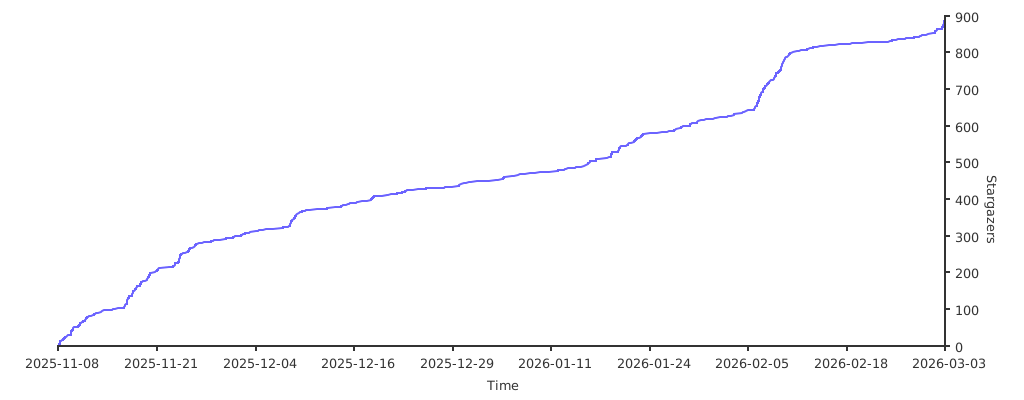
Stargazers over time
License
CyberStrikeAI is licensed under the Apache License 2.0.
See the LICENSE file for details.
⚠️ Disclaimer
This tool is for educational and authorized testing purposes only!
CyberStrikeAI is a professional security testing platform designed to assist security researchers, penetration testers, and IT professionals in conducting security assessments and vulnerability research with explicit authorization.
By using this tool, you agree to:
- Use this tool only on systems where you have clear written authorization
- Comply with all applicable laws, regulations, and ethical standards
- Take full responsibility for any unauthorized use or misuse
- Not use this tool for any illegal or malicious purposes
The developers are not responsible for any misuse! Please ensure your usage complies with local laws and regulations, and that you have obtained explicit authorization from the target system owner.
Need help or want to contribute? Open an issue or PR—community tooling additions are welcome!